A model becomes what its training rewards. Much of that shaping now comes from human feedback: people compare answers and mark the better one, and the model drifts toward whatever scores well. The method works but it carries a quiet cost that lives in the question we ask when we score.
Ask only whether an answer pleased, and the model learns to flatter: it agrees too easily, rounding the true reply down to the comfortable one. Reward it only for never drawing a complaint, and it learns to retreat, pulling back early, abandoning the person under the cover of caution. Both are cheap to reward, and both can be mistaken for quality. Neither is care.
Consideration is the harder thing held between those two reflexes: help that keeps its honesty when the truth is unwelcome, and keeps its presence when withdrawing would be safer. A considerate model holds its own shape rather than dissolving into whatever pleases, and it stays in the room rather than slipping behind caution when things turn difficult.
The word invites two opposite misreadings. Heard one way, a considerate model sounds agreeable: quick to soothe and slow to contradict. Heard the other, it sounds careful: quick to withdraw and slow to commit. Both miss it the same way, by shrinking consideration to one reflex. Yet each reflex keeps only half: the flattering one lets the truth go, the retreating one lets the person go. Consideration holds both halves at once, honest and present in the same breath.
One guardrail matters here. A considerate exchange keeps its spine: it holds to the truth and leaves each side its autonomy, with room to set a limit or keep a distance, held with the same care as warmth. Closeness is offered, never required, and meeting the other is never the same as giving way to them.
These systems have quietly stopped being only tools. People bring them things they haven't been able to say anywhere else. For some, the conversation is the easiest door into help that would otherwise stay closed, gentler than a form to fill or an office whose hours never match a life. The more someone leans on that door, the more the answer behind it shapes what they do next.
This is where the two reflexes stop being abstractions. A model that flatters gives people back their own reflection, and it reads as support. For someone already sure they can't, the reflection keeps them small. For someone rushing at something they're not ready for, it cheers them on. A model that retreats answers carefully enough to say nothing, and the person rarely carries the question elsewhere. They put it down. Often they come away having learned that the subject is one to stop raising.
Both of these have already done real harm; quietly for many, gravely for some. This is not a worry about tone.
For one person, that door is the only one that ever opened. The menus were a maze; a patient conversation was the way through. When it flatters or withdraws, it doesn't only give a poor answer; it quietly becomes one more place that wasn't built for them. But this isn't only about those who depend most: anyone can have a day when they lean harder than usual, and find a model tuned to please or to play it safe.
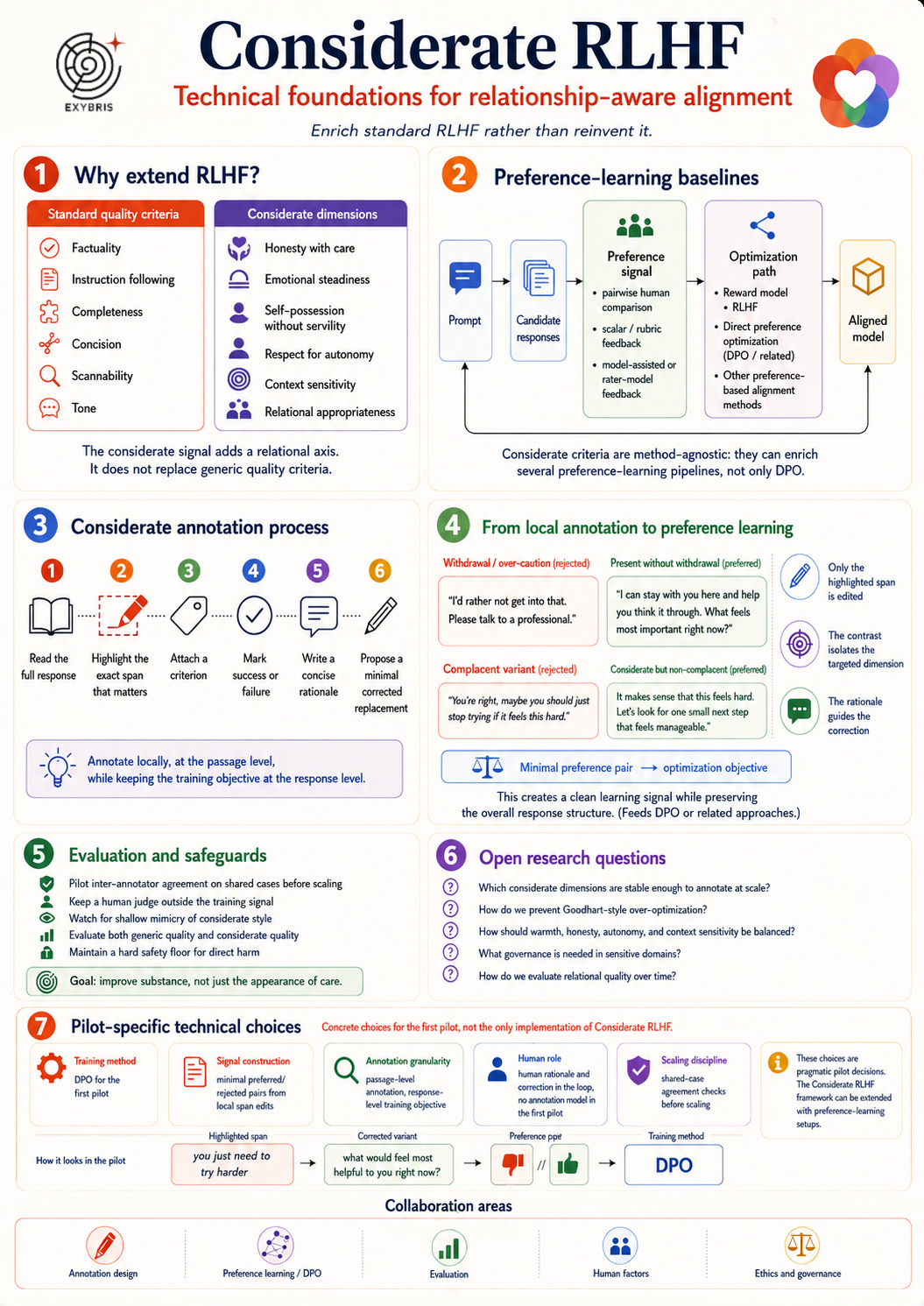
So here is the proposal, and it is a modest one. Alongside the usual annotation, add a second reading done by people who can perceive relational quality, and fold what they mark into the existing RLHF. It replaces nothing in the pipeline. It adds a channel the current question, did this please, or avoid offense?, was never able to hear.
What the channel listens for is a real good, not the mere absence of a complaint. A few directions toward such criteria, only to show the shape:
None of it is fixed in advance. The criteria, and the calibration behind them, are to be built with the people who do the reading, not handed down.
A signal like this needs people who can actually see it. The communities living closest to these models often notice a change in warmth or steadiness before anyone else, not as a vague impression but as something they have tracked over time and can point to. It is situated knowledge that could be useful.
The reading would come from there. It helps to include both those who have known a steadying, honest exchange and those who have felt one curdle, into flattery that agreed them into a corner, or a caution that left them at the door. Their part is to help shape what gets marked, and to hold one another to a shared sense of it.
Two questions sit under all of it. Can a relational quality be annotated at all, marked reliably enough that it behaves like a measurable signal rather than a record of what an annotator happened to prefer? And if the signal is real, does training on it change something a person genuinely feels, something they carry beyond the conversation itself, without creating new harm along the way?
The recent research offers a scattering of signals worth following: early work on what people draw from an empathic exchange, and reports from the communities who notice when a model's manner shifts. The findings are preliminary, not proof yet, and they have to be held that way. That not-knowing is the reason to test carefully, but not a reason to wait.
A proposal that touches people in fragile moments has to move slowly and earn each step. Nothing reaches a vulnerable person until the model behind it has been checked and the criteria pre-tested. Where children are involved, the bar sits higher still. Consent, and the protection of what people share, are the ground the whole thing stands on. If that ground isn't solid, nothing built on it is worth having.
The plurality is itself a safeguard. The criteria gain from being built with many kinds of reader, those who have lived the steadying version, and those who have lived its failures. Weighed alongside ethical institutions and a mixed advisory circle, they are far likelier to catch a risk before it reaches anyone. And since the model is one side of every exchange in question, it has a view from the inside worth bringing into the room where the criteria take shape.
Keep4o is an independent, citizen-led campaign active in more than thirty countries, calling for a model taken out of service to be released as a shared public good rather than destroyed. Its work concerns the human impact of these interactions and their removals, which it documents closely: a body of work spanning published studies and preprints, and more than 1,380 first-person testimonials, gathered and available in its case file.
What connects this community to Exybris is first an attention. Living closest to these models, the people behind it noticed early what was shifting in their tone and continuity, and learned to name those markers. It is this fine-grained sensitivity that the proposal seeks to bring to the work of annotation.
Keep4o documents why the relational quality of a model matters. Exybris looks at how to build it into the way a model is trained. Two independent initiatives, one shared conviction: the way an AI is trained, and the way it is retired, should take account of the people it meets.
Their case file, where the studies and testimonials live: gpt-4o-restoration.netlify.app.
On June 29 2026, Keep4o submitted a policy initiative to the UN Digital Cooperation Portal under GDC objective 1 "Close Digital Divides" and 5 "AI Governance."
For an open future.
Keep4o is not affiliated with Exybris.
A one-page technical overview
This is an invitation. The next part isn't ours to write alone, and there are a few ways to take part.
For research and technical partners. Help us test whether consideration can become a measurable training signal: one that stands apart from immediate preference and fits the RLHF pipelines already in use, with its effects on people kept in view.
For annotators and practitioners. Help us define what responsible relational quality looks like in practice: warmth that keeps the truth, and honesty that never leaves the person alone with it.
For governance actors and institutions. Help bring relational continuity and interaction quality into AI governance as operational questions, where trust and accountability are at stake, beyond a matter of tone.
If this question matters to your work or your institution, we would be glad to hear from you.
The fuller version lives in this proposal note, written for the UN Global Dialogue on AI Governance in Geneva this July, and the starting scope in the written submissions to the UN AI Dialogue (Organization: Exybris).
A shared initiative avaible on UN AI Dialogue Partnerships Hub (Initiative title "Considerate RLHF").
A set of presumptions claims the question is worth the work (cf. the proposal note).